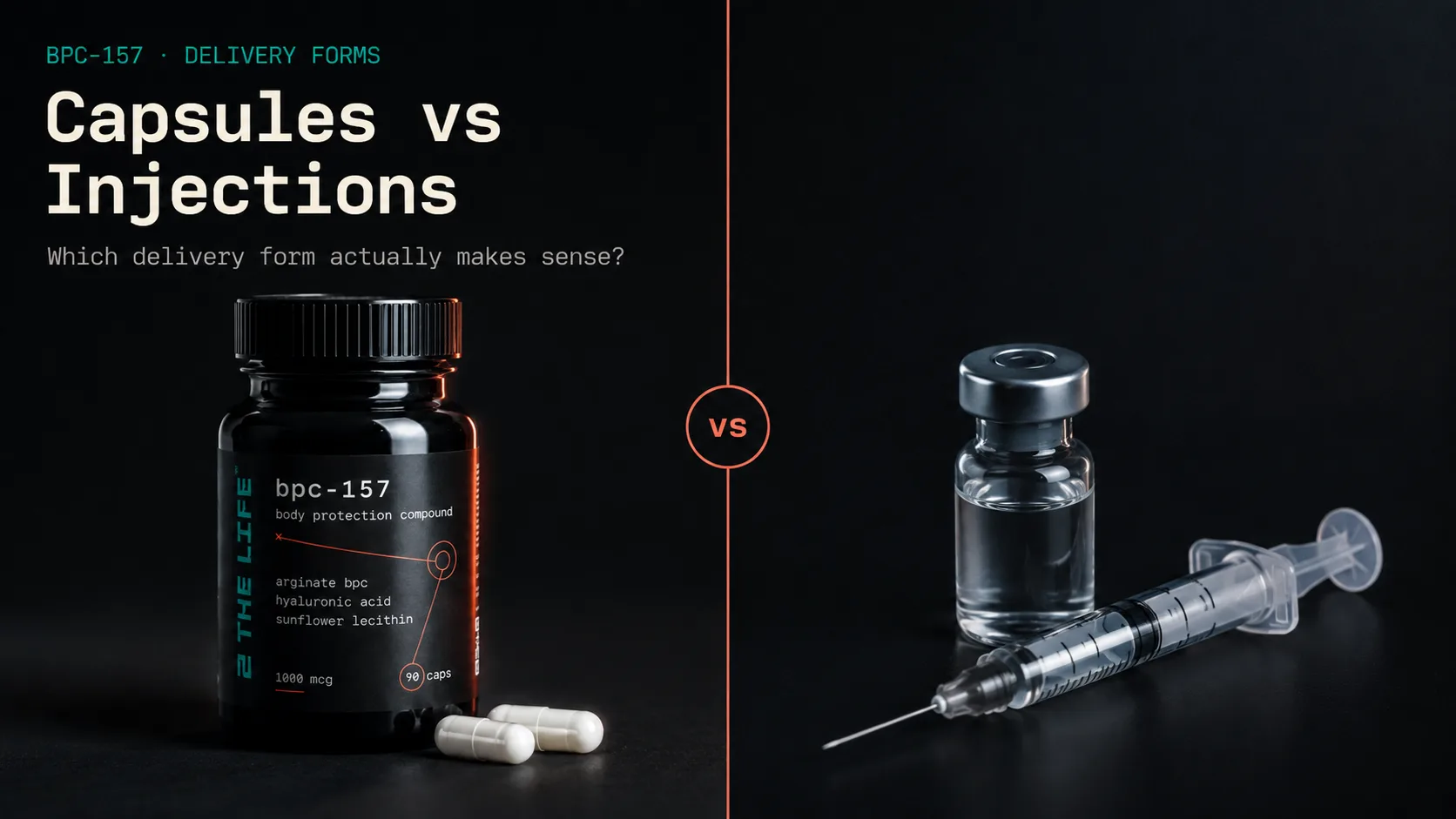
BPC-157 capsules and injections are often presented as interchangeable ways to obtain the same benefits. The evidence reviewed here does not establish that either route treats a particular condition, or that one is clinically safer or more effective than the other. Route comparisons should begin with those unanswered questions.
Evidence checked September 10, 2026. This guide explains how to assess route claims; it does not provide a dosing or self-administration protocol.
What a meaningful comparison would measure
A capsule, an injection into a joint and an intravenous infusion are different interventions. Evidence for one cannot automatically support another. A useful comparison would specify the formulation, participants, condition, comparator and follow-up, then measure both patient outcomes and adverse effects. More drug reaching the bloodstream would not, by itself, prove more benefit.
Even two products described as BPC-157 may differ in chemical form, purity, additional ingredients and release characteristics. A study using one preparation cannot validate every product sharing its name. The relevant question is whether the exact intervention has been tested for the exact purpose being claimed.
Oral stability is not the same as human absorption
Statements about surviving stomach conditions do not establish how much intact peptide reaches human blood or a target tissue. They also do not establish a therapeutic effect within the gut. These require separate measurements: pharmacokinetics for exposure, and clinical trials for benefit.
An oral study was registered as NCT02637284 [1]: a placebo-controlled phase 1 investigation of PCO-02 tablets, with an estimated 42 healthy volunteers. At this review, its status was unknown, its last posted update was December 22, 2015, and no results were posted in the registry. Registration describes a research plan; it does not show that the planned enrollment occurred or that oral BPC-157 worked. FDA's July 2026 briefing also reported no identified human pharmacokinetic data for oral administration. [5]
What the injection reports actually studied
A 2021 knee-pain report reviewed 17 patients' records and obtained telephone responses from 16. Some received BPC-157 alone and others a combination with thymosin beta-4. Without a comparison group, recalled improvement cannot isolate an effect of BPC-157 or demonstrate cartilage or tendon repair. This was a study of joint injections, not capsules. [2]
A 2025 intravenous pilot involved just two people, both previously exposed to intravenous BPC-157. Its brief observation and laboratory checks cannot resolve uncommon harms, safety with repeated use, or effectiveness for an injury. It did not compare injections with oral products. Neither report establishes the effects of subcutaneous administration. [3]
Safety cannot be ranked by convenience
Avoiding a needle does not establish a medicine's overall safety. FDA identifies potential immune reactions, peptide-related impurities, difficulties characterizing the ingredient and insufficient safety information for proposed routes. These concerns do not establish a safe oral alternative. [4]
FDA's July 2026 advisory meeting considered BPC-157 in the context of compounding. An advisory discussion or recommendation is not approval of a finished drug and does not establish clinical benefit. [6]
Questions that help evaluate a claim
- Does the cited study involve people with the relevant condition and the same administration route?
- Was improvement compared with placebo or established care, using predefined outcomes?
- Were other treatments and combined ingredients accounted for?
- How were adverse effects collected, and was follow-up long enough for the proposed use?
If you are considering BPC-157 for persistent pain or digestive symptoms, discuss the diagnosis and established treatment options with a qualified clinician. Do not replace prescribed treatment or choose a route based on marketing comparisons. Our BPC-157 research review explains how laboratory findings differ from evidence of benefit in patients.
Sources
- ClinicalTrials.gov: NCT02637284, PCO-02 safety and pharmacokinetics study.
- Lee and Padgett: knee-pain retrospective study. Altern Ther Health Med. 2021;27(4):8–13.
- Lee and Burgess: intravenous safety pilot. Altern Ther Health Med. 2025;31(5):20–24.
- FDA: compounding safety information, BPC-157 entry.
- FDA: July 2026 BPC-157 briefing, page 39.
- FDA: July 23–24, 2026 advisory meeting.